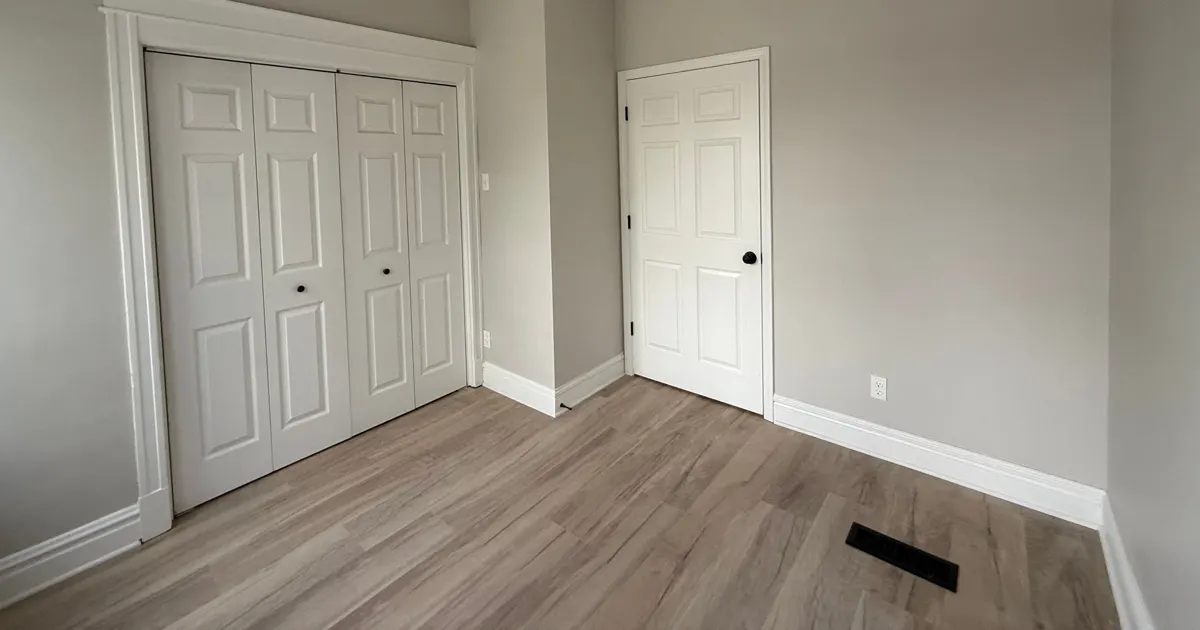
Luxury Vinyl Plank is the floor we are asked about most. It looks like wood, handles water and pets, and it is a good fit for kitchens, basements and rentals. It is also a floor where two quotes for the same room can look nothing alike. Usually that is because one of them leaves things out.
Here is what actually moves the price of an LVP job, and the questions to ask any installer, including us.
What drives the cost
1. Square footage, and the shape of the room
The obvious one. But layout matters as much as size. An open rectangle goes down quickly. Hallways, closets, angled walls and lots of doorways mean more cuts and more time for the same square footage.
2. What is underneath
LVP needs a flat subfloor. Rigid core planks will bridge small dips, but a floor that is out of flat will make planks flex, click joints fail and edges lift. Leveling low spots or sanding high ones is often the biggest difference between quotes.
3. Taking the old floor out
Pulling carpet and pad is quick. Glued down vinyl, ceramic tile or old hardwood is not. Ask whether removal and haul away are in the number.
4. The product itself
Plank thickness, the wear layer (the clear top coat, measured in mil), and the core type all change the price. A thicker wear layer stands up better to pets, kids and rental turnover. Rigid core (often called SPC) is stiffer and more forgiving of small subfloor flaws than flexible glue down planks.
5. Stairs, transitions and trim
Stairs are slow, careful work and are usually priced separately. Every place the new floor meets a different floor needs a transition. Then there is the trim: reinstalling baseboards, or adding quarter round to cover the expansion gap.
6. Doors, appliances and furniture
Door jambs usually need undercutting so the plank slides under. Doors sometimes need trimming. Fridges, ranges and furniture have to move out and back.
7. Basements and moisture
LVP is a great basement floor, but concrete slabs can carry moisture. Depending on the product, that can mean a vapor barrier or a specific underlayment.
Questions to ask any installer
- Will you check the subfloor for flatness, and is leveling included?
- Is removal and disposal of the old floor in the price?
- Do you undercut door jambs, and will any doors need trimming?
- How are transitions handled at each doorway?
- Do you reinstall the baseboards, or add quarter round?
- Who moves furniture and appliances?
- Does the product need to acclimate, and does the manufacturer require a specific underlayment?
- Exactly which rooms and how many square feet does the quote cover?
Why we do in person estimates
Every one of the factors above is something you can only see in the room. That is why every HandyPros flooring job starts with an in person estimate: we check the subfloor, measure every room, look at transitions and door clearances, and give you a number that will not change halfway through.
If you want a ballpark first, email a few photos and room sizes to [email protected] and we will send you a rough idea before you book.
Rather have a Pro handle it?
LVP (our most requested), tile, laminate and peel and stick.
Quick answers
Is LVP good for basements?
Yes. It is one of the best basement floors because it handles moisture well. Some products need a vapor barrier or specific underlayment on concrete.
Can LVP go over my old floor?
Sometimes, if the old floor is flat, firmly attached and not too thick. We check this during the in person estimate.
How do I get a ballpark?
Email photos and room sizes to [email protected]. Every final price comes from an in person estimate.